

Tē tōia, tē haumatia
Nothing can be achieved without a plan, workforce, and way of doing things
Photo by David Hallett
Stoat eradication project
Stoats have been described as ‘public enemy number one’ for New Zealand’s native birds, they are relentless, skillful hunters and prolific breeders.
Waiheke's resurgent birdlife is a good sign that stoat numbers are low, but it will take even more effort to get to zero, protect these gains, and allow wildlife to thrive even further.
Why eradicate stoats?
Stoats are relentless predators of native birds and other wildlife. Ground-nesting and hole-nesting birds are particularly vulnerable, but none are safe.
Project progress
The first part of Te Korowai o Waiheke’s programme is the permanent removal of stoats, because of the significant damage they do to our native wildlife.
Project overview
The stoat eradication programme on Waiheke Island predominantly uses traps based on a network of one trap per six hectares across the entire island.
Do you know how many stoats there are on Waiheke Island, or how far a stoat can swim? Get answers to all your stoat questions here.
Don’t delay, report a stoat today!

Community stoat sightings have been critical to the success of the project so far. Allowing the team to quickly focus on the right areas.
Let us know the location of the sighting, the direction the stoat was travelling in, and, if possible, a contact phone number.
We are very keen to hear about any stoat sightings. Please call us on 0800 BIRDSONG, email frank@tekorowaiowaiheke.org, or fill out this form.
Eradication project progress
Keep up to date with the stoat eradication project's progress using the live dashboard below.
The stoat catch 'heat map' shows the hotspots where most stoats have been caught!
Project overview

The stoat eradication programme on Waiheke Island predominantly uses an extensive network of traps, with one trap every six hectares – a total of 1,787 traps! These traps are checked and serviced by a committed team of volunteers, contractors, farm staff, community groups, park rangers, and the Te Korowai o Waiheke field team.
DOC 200 traps have been tried and proven to be the most useful at catching stoats. They are deployed along linear features (e.g. roads, tracks, forest, pasture, wetland edges) which stoats like to follow. Every trap is enclosed in a custom-designed box making it very hard for non-target animals to get in. A small number of “live” traps may be deployed around ‘areas of interest’ to attempt to catch the wiliest stoats, these are fitted with transmitters to notify us if the trap has been triggered. If you see an animal in a “live” trap call 0800 BIRDSONG.
With stoat numbers down to low numbers, the project has moved to the ‘detect and respond’ phase to focus on catching the craftiest stoats.
Innovation, in terms of trap types, bait, and methods is also now a focus to catch the stoats that have avoided DOC 200 traps so far.
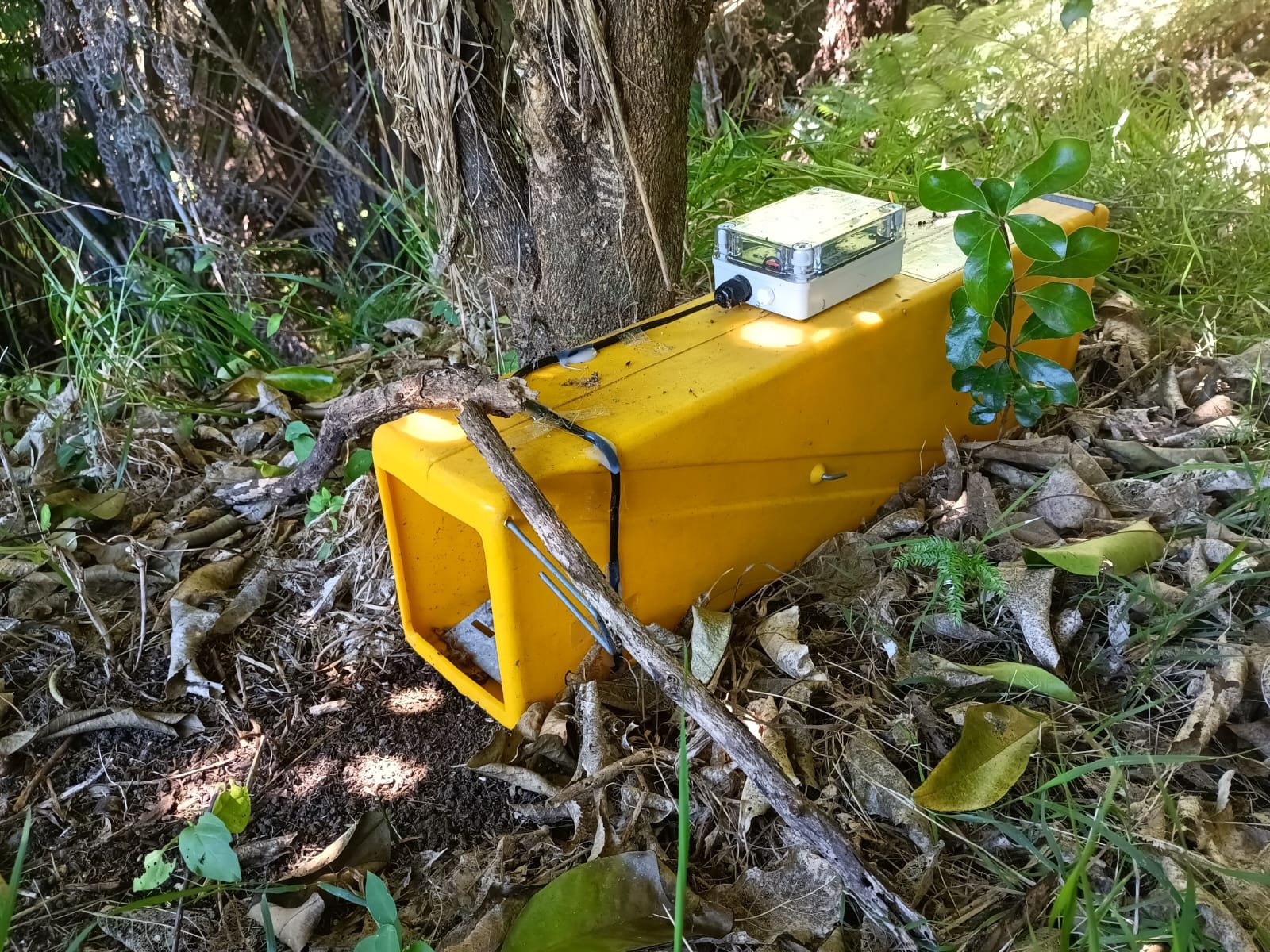
Holden Trap - “Live” Trap
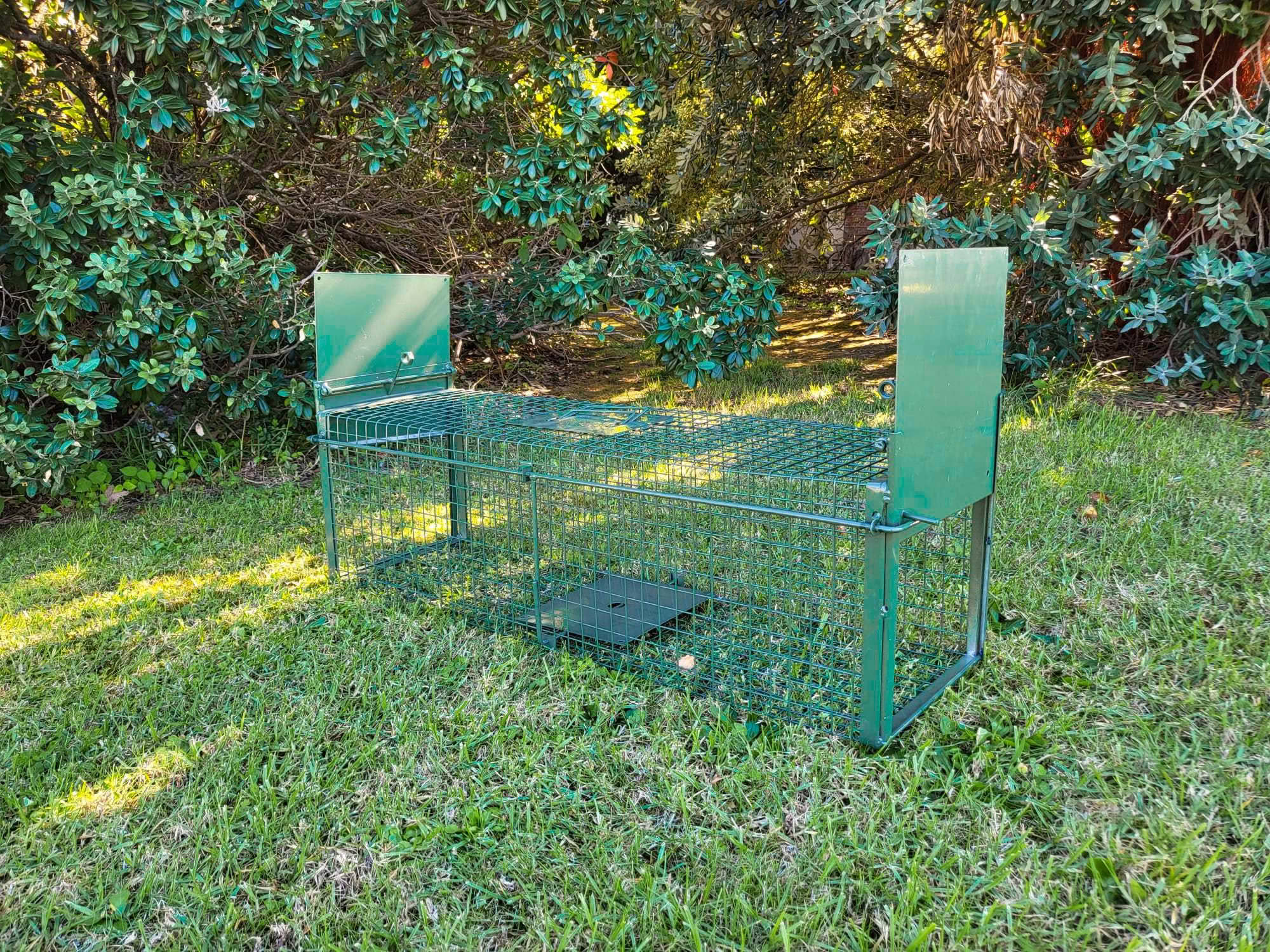
Double Entry Cage - “Live” Trap
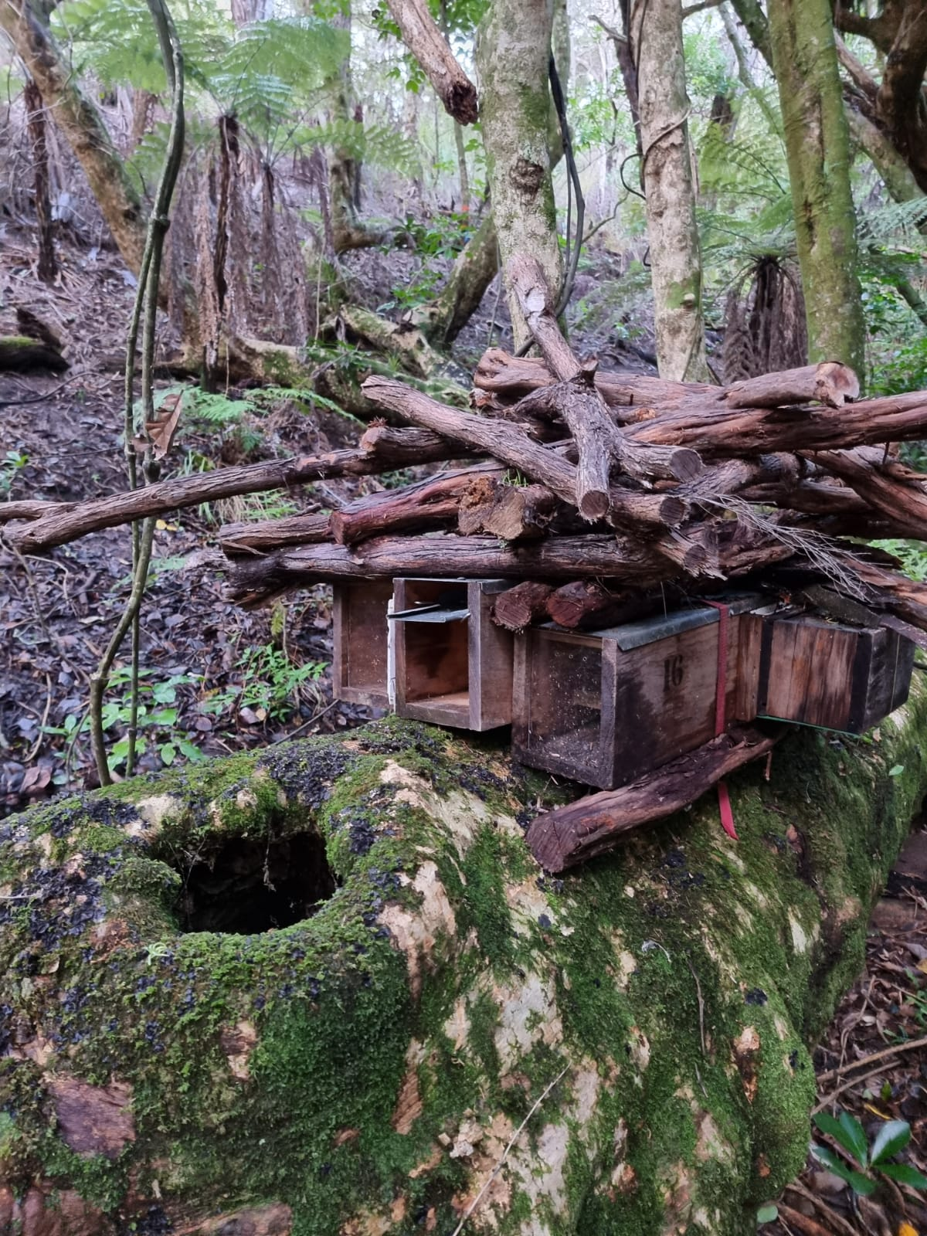
Edgar Cage - “Live” Trap

Detect
Community stoat spotting - The 9,000 pairs of eyes on the island have proved invaluable as a first step in identifying new areas of interest for traps and in confirming existing areas with active stoats.
Detection Dogs - Detection dogs are increasingly being used to detect stoat scent or scat (poo), especially around areas where there has been a stoat sighting. This allows the team to really fine-tune trap placement.
Trail cameras - Motion sensing and AI cameras are set up across the island to monitor and detect stoat activity.

Respond
Speed - As soon as there has been a stoat sighting, the team can respond and deploy traps in the area. Stoats move quickly, so the team needs to as well.
Fine-tuning - With the help of detection dogs, the placement of traps can be optimised around trails or spots where scat or scent has been found.

Innovate
Traps - Almost every type of trap is being utilised and new setups are being tried to outwit the last stoats. These have included a 200-metre line of fencing to funnel stoats into traps, traps on poles to use in the wetlands, and traps disguised in the environment (from organic material to discarded cushions).
Lures - Every smell is also being tried to tempt the fussiest stoats. Bait tried has included fish oil, sardines, ferret scent, salmon spray, stoat bedding, mayonnaise, meatballs…. and one intrepid volunteer was even successful using otter poo, sourced from Auckland Zoo. Sound recordings of other stoats have also been used.

Stoat raiding a Kākā nest - Department of Conservation
Why eradicate stoats?
Stoats are relentless predators of native birds and other wildlife. Ground-nesting and hole-nesting birds are particularly vulnerable - but none are safe.
Stoats were deliberately shipped from the UK in the late 1800s to control the rabbit population, despite warnings from eminent New Zealand scientists. They quickly began to decimate the native bird population, and are responsible for several extinctions.
Hole-nesting birds like kākā and ruru (morepork), ground-dwelling birds like korora (little penguin), and our iconic kiwi are particularly vulnerable to stoats. Stoats are the main reason 95% of kiwi hatched in the wild die before they reach breeding age which especially devastates vulnerable bird populations.
While their main prey are defenceless birds, they also prey on insects (particularly wētā), mice, rabbits lizards, and pretty much anything else that moves.

Based on diet of South Island Stoats. (King C. M. & J.E. Moody J. E. 1982a. The biology of the stoat (Mustela erminea) in the National Parks of New Zealand: I. General introduction. New Zealand Journal of Zoology, 1982, Vol. 9: 49-56)
Stoat teeth are perfectly adapted for hunting, with razor-sharp canines that allow them to catch prey and deliver a lethal bite through the neck or skull. This enables stoats to kill animals much larger than themselves.
Stoats have enormous appetites, males must eat a quarter of their body weight daily while lactating females need to devour half of their body weight. For a 70kg human female - this would be the equivalent of 308 quarter pounders every day!
Stoats are highly skilled and ruthless hunters, equipped with exceptional eyesight, acute hearing, and a powerful sense of smell, enabling them to hunt both day and night. Their agility extends to climbing trees, making no bird truly safe, and their speed allows them to catch any native wildlife and cover long distances with ease.
Stoats will kill far more than they need, hiding the surplus to potentially consume later. This behavior stems from their European origins, where food storage was essential for surviving harsh winters. However, with New Zealand's mild winters, they don’t need to store food but are hard-wired to kill anyway. This instinct results in an incredibly high death rates in native birds.
Stoats are prolific breeders, adding to the challenges they pose. A mother stoat typically has 6–12 kits and can become pregnant as a blind and deaf 2-week-old. Interestingly, while she may be pregnant at this young age, the mother kit’s development and the birth of more kits is delayed until she reaches adulthood, with all kits being born the following spring.

Keeping Waiheke stoat-free
Many of the islands surrounding Waiheke are already predator-free and because of these islands, as well as the distances between them, it is unlikely that stoats will swim back. This has been evident in all DNA analysis conducted since the project began, with no new stoat DNA appearing from new invaders in the last 10-15 years.
The surrounding predator-free islands have stoat traps, and monitoring devices to catch any invading stoats. Stoats generally swim one to three kilometres but have been known to swim up to five kilometres.
Te Korowai o Waiheke is working in partnership with Pest Free Hauraki Gulf (a joint initiative between Auckland Council and the Department of Conservation), to help protect conservation islands in the Hauraki Gulf to establish a biosecurity programme to prevent stoat re-invasion to Waiheke.
Predator-free islands and distances between them


Stoats FAQs
-
We are not sure exactly how many stoats are left on Waiheke Island, but the resurgent kākā population would indicate that its now down to low numbers . The damage done to native birds from even one stoat is large, given they need to eat a quarter of their body weight every 24 hours. Stoats have been caught all around the island, with the majority caught close to the coast or waterways.
-
The stoat eradication programme involves placing traps at regular intervals (approximately one trap per six hectares) across the entire island, which equates to more than 1,700 traps!
-
A community stoat spotting campaign, stoat detection dogs and detection cameras are used to locate stoats on the island.
-
Stoats usually swim between 1-3 kms, but have been known to swim up to 5 kms. It is therefore possible for a stoat to swim (or ‘island hop’) from mainland Auckland to Waiheke. However there are several predator-free islands on their likely swimming paths with robust predator prevention re-invasion programmes, which act like a buffer for Waiheke.
-
Every trap is enclosed in a custom designed box that has a series of wire mesh panels with entry holes cut in. The size of these entry holes make it hard for pets to get into the trap area. In addition, the trap boxes either have an elongated entrance area or a weka proof extruder fitted to the outside of the trap box . Please talk to the field team on info@tekorowaiowaiheke.org or 0800 BIRDSONG if you have any specific concerns regarding existing or planned pet additions to your household.
Stoat eradication plan - pdf downloads
Rats
Rats have a devastating effect on native wildlife and plants and also cause damage to property, crops, and human health.